
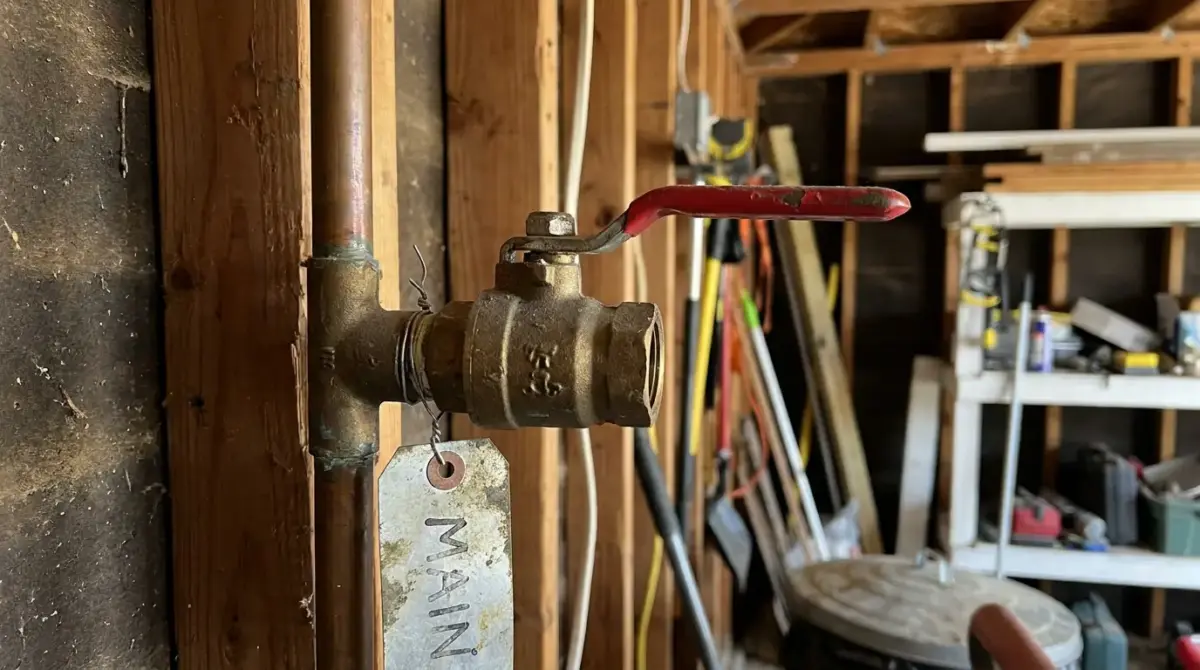
The water shutoff valve is the single most important plumbing component in your house — and most DFW homeowners couldn’t find it under pressure if a pipe burst right now. This guide walks Dallas-Fort Worth homeowners through locating, testing, and labeling the main water shutoff valve so the next plumbing emergency stays small instead of becoming a flood claim.
Walk through this guide once. Find your valve. Test it. Show everyone in your household. Done — you’ve just added significant protection to your home for $0.
Why This Matters in DFW
Texas freeze events, slab leaks, water heater failures, washing machine hose bursts — all four are common in North Texas, and all four spray water into your home until someone closes the main water shutoff. Every second matters. A pipe spraying 5 gallons per minute fills a room with water in under 15 minutes. Finding the valve in the dark while sleep-deprived isn’t the time to learn where it is.
Where the Main Water Shutoff Usually Lives in DFW
In most DFW homes, the main shutoff is one of three places. Check each in order:
1. Outside Near the Front of the House
Look at the front of your house near where the city water line enters from the meter at the curb. You’ll often see a vertical pipe rising from the ground with a quarter-turn valve handle, often near an outdoor faucet. This is the most common location for DFW homes built 1990 or later.
2. In the Garage
Many DFW homes route the main water line into the garage near the water heater. Look at the wall that the garage shares with the house. The line often enters here with a shutoff valve mounted just inside.
3. At the Water Heater
Some smaller homes have the main shutoff valve right next to the water heater. This isn’t the cold supply to the water heater specifically — it’s the actual main for the whole house. Usually labeled or oversized compared to fixture supply lines.
4. At the Curb (Last Resort)
Every property also has a city-side shutoff at the meter box near the curb. This requires a long-handled curb key tool (about $25 at any DFW hardware store) to operate. Use this only if you can’t find your house-side shutoff in an emergency. The Texas Commission on Environmental Quality drinking water program requires every residential meter to have a working curb stop.
Two Types of Shutoff Valves
Quarter-Turn Ball Valve (Modern)
A lever handle that turns 90 degrees. Handle parallel to pipe = OPEN. Handle perpendicular to pipe = CLOSED. Reliable, fast, easy to operate even by kids. This is what’s in most DFW homes built after 1990.
Gate Valve (Older)
A round wheel handle that turns multiple times. Counterclockwise to open, clockwise to close. Gate valves seize up over years of disuse — many DFW gate valves haven’t been turned in 20+ years and snap when finally rotated. If you have an old gate valve, plan to replace it with a quarter-turn ball valve ($150-300 installed).
Test the Valve Right Now
- Turn on a cold water faucet anywhere in the house
- Go to the main shutoff valve and close it
- The faucet should slow to a drip within 30-60 seconds, then stop entirely
- If water keeps flowing, the valve isn’t sealing — needs replacement
- If the handle won’t budge or snaps when you turn it, the valve has seized — needs replacement
- Reopen the valve, confirm normal flow returns at the faucet
Test once a year. A valve you’ve never turned is a valve that won’t work when you need it.
Label and Communicate
Once located and tested, do these three things:
- Attach a bright tag or label to the valve: “MAIN WATER SHUTOFF”
- Take a photo and text it to every adult in the household
- Add the location to your home emergency information sheet
If you’re traveling, the person watching your house should know where the valve is. If kids are old enough to babysit, they need to know.
Also Locate Individual Fixture Shutoffs
Every toilet, every sink, the water heater, and the washing machine each have their own shutoff valves. Most are angle stops under the fixture. Knowing these means a leaking toilet supply line doesn’t require shutting down the whole house — just close the toilet’s angle stop and call a plumber.
Smart Water Shutoff Valves
Newer technology: motorized main shutoff valves that connect to your home Wi-Fi and automatically close when leak sensors detect water. Brands like Phyn, Moen Flo, and Flume monitor your plumbing 24/7 and shut off the main if they detect catastrophic flow.
Install cost: $400-800 plus $200-400 for plumber installation. Worth it for DFW homes that sit empty during the day, vacation properties, or homes that have already had one major water event. The Insurance Information Institute reports that water damage is the second most common insurance claim — smart shutoff systems can dramatically reduce that risk.
When to Replace the Valve
- Gate valve that’s been in place 20+ years — replace proactively before it seizes
- Valve fails to fully stop water flow during testing
- Visible corrosion or green patina on the valve body
- Handle snaps or won’t move during testing
Replacement of a main shutoff valve is typically $200-500 in DFW. Cheap insurance against your next plumbing emergency.
Bottom Line
The water shutoff valve is the cheapest disaster prevention any DFW homeowner can buy — because you already own it. Find it today. Test it today. Label it. Show your household. Replace it if it’s a seized gate valve. The next time a pipe bursts, you’ll save thousands of dollars by closing the valve in 30 seconds instead of 30 minutes.
Trusted Local Network
Knowing where your main shutoff is matters when a plumbing emergency overlaps with other home emergencies. For related needs, we recommend emergency plumbing services in the San Diego area.
Your DFW Water Shutoff Specialists
If you can’t find your main water shutoff, the valve is seized, or you want a smart shutoff installed, PACT Plumbing serves Dallas, Fort Worth, Plano, Frisco, McKinney, Carrollton, Keller, Southlake, Grapevine, and Roanoke with full plumbing service and repair including valve replacement. Contact us today.