
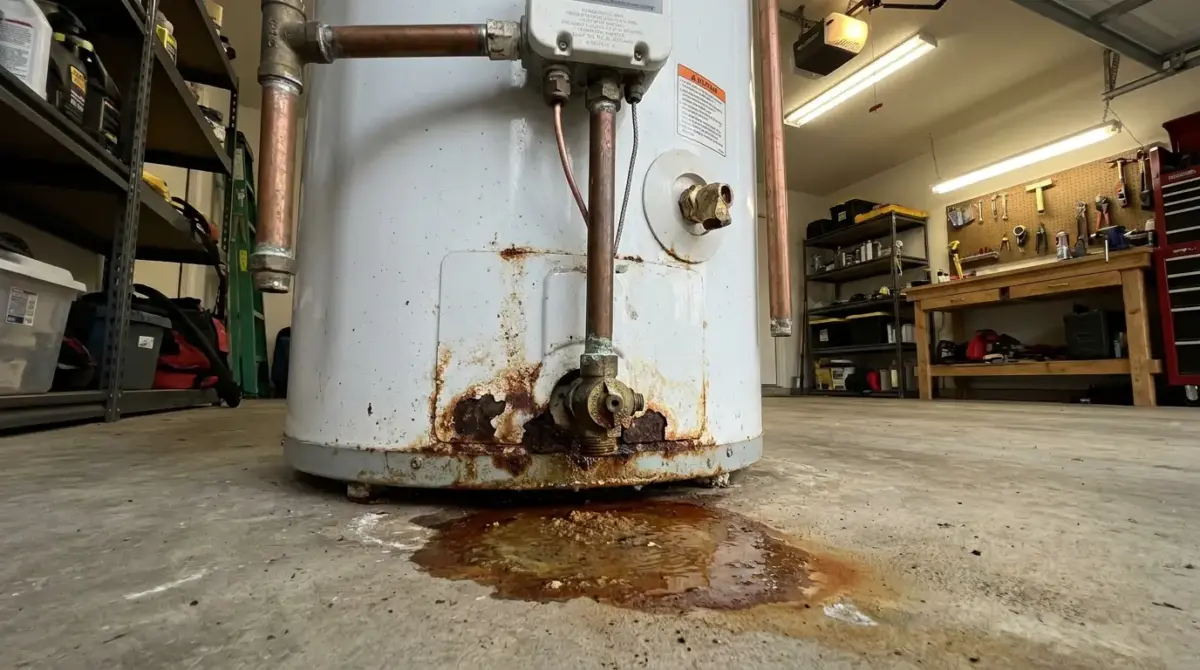
Water heater failure is the most common plumbing service call across Dallas-Fort Worth — and DFW has some unique reasons your water heater keeps going out faster than the manufacturer’s warranty promises. This guide walks Texas homeowners through what’s actually happening inside the tank, the five reasons it fails early in our climate, and what each fix really costs.
Heading into winter? Garage-mounted tanks and tankless units are among the first things to suffer in a North Texas hard freeze. See frozen pipes in DFW and how to protect them for the freeze-protection checklist.
If you’ve replaced two water heaters in the time most homeowners replace one, you’re not unlucky. You’re living in DFW.
1. Hard Water Sediment Buildup
The biggest killer. DFW’s extreme hard water deposits calcium and magnesium at the bottom of every tank water heater. Over a few years, that sediment forms a thick crust between the burner and the water above. The burner has to run longer and hotter to heat through the insulating layer. Eventually the tank itself warps from the heat stress, or the heating element burns out.
Symptoms: popping or banging sounds when heating, hot water that takes forever to arrive, hot water running out faster than it used to, the tank running constantly.
Fix: annual tank flush. Connect a hose to the drain valve, open the temperature-pressure relief valve, drain until the water runs clear. Takes 30 minutes. Or have a plumber do it as part of an annual service. Skip this for 5 years and your water heater pays the price.
2. Failed Anode Rod
Every tank water heater contains a magnesium or aluminum “sacrificial anode rod” that corrodes instead of the steel tank. Once the anode is fully consumed (typically 4-6 years in hard water), corrosion attacks the tank itself. Tank corrosion is unfixable.
Symptoms: rusty hot water, metallic taste, visible rust on the top of the tank.
Fix: $30 anode rod replacement. Has to be done before the tank corrodes. Once you see rusty water, it’s usually too late. The US Department of Energy water heater maintenance guide recommends anode inspection every 3 years for hard-water areas.
3. Thermal Expansion Issues
Modern DFW homes typically have closed plumbing systems (pressure regulator or check valve at the meter). Heated water expands. With nowhere to expand to, pressure inside the tank cycles high. Over time this stresses the tank, causes the temperature-pressure relief valve to leak constantly, and shortens lifespan.
Symptoms: T&P relief valve dripping or running, water heater making “stretching” sounds.
Fix: thermal expansion tank — a small bladder tank installed on the cold supply line. Required by Texas code on closed systems. Installed cost typically $200-400.
4. Gas Valve or Pilot Issues (Gas Heaters)
Pilot lights blow out. Thermocouples fail. Gas valves clog or stop responding. Texas summers run gas water heaters hard because so many DFW homes also run high hot-water demand for laundry, showers, and pools.
Symptoms: no hot water, pilot won’t stay lit, error codes flashing on the gas valve.
Fix: thermocouple replacement ($50-150 part), gas valve replacement ($200-500), or pilot relight per manufacturer’s instructions on the side of the tank.
5. Undersized Water Heater
The original builder spec was based on a 2-person household. You’re now 5 people with two teenagers. The 40-gallon tank runs out in the middle of every shower. It’s not actually broken — it’s overworked, which dramatically shortens lifespan.
Symptoms: hot water runs out predictably during high-demand periods, recovery time feels slow.
Fix: upgrade to a larger tank (50 or 75 gallon) or convert to tankless. Tankless makes sense for DFW homes with 4+ people and good gas service. Endless hot water, smaller footprint, 20+ year lifespan.
When Repair Doesn’t Make Sense
Some failures call for replacement, not repair:
- Tank is over 10 years old and shows visible rust
- Water pooling under the tank (means the tank itself is leaking)
- Repair cost exceeds 50% of replacement cost
- Energy bills are climbing for no obvious reason (old units lose efficiency)
A new ENERGY STAR-rated tank water heater pays back in 3-5 years through lower energy bills. ENERGY STAR’s water heater guide has efficiency comparisons.
Tankless vs Tank Water Heater for DFW
If you’re replacing rather than repairing, the tankless question comes up immediately in DFW. Quick comparison:
- Tank water heater — lower upfront cost ($1,200-2,500 installed), familiar tech, 8-12 year lifespan in DFW hard water
- Tankless water heater — higher upfront cost ($3,000-5,500 installed), endless hot water, 20+ year lifespan, lower energy bills, smaller footprint
Tankless makes sense for DFW homes with 4+ people, growing families, or properties with no good water heater closet space. Tank still wins on first-cost and simplicity for smaller households.
Either way, install a thermal expansion tank and an in-line water softener if you don’t already have one. Both dramatically extend water heater lifespan in DFW.
Water Heater Lifespan Expectations in DFW
National averages don’t apply in North Texas. Realistic lifespan expectations for DFW:
- Standard gas tank water heater: 8-10 years (vs. 12 nationally)
- Standard electric tank water heater: 10-12 years (vs. 14 nationally)
- Tankless gas water heater: 18-22 years
- With water softener installed: add 3-5 years to any of the above
If your water heater is approaching the upper end of the expected lifespan, start planning the replacement on your terms — not at 2 AM on a Sunday when the tank fails.
Maintenance Schedule to Maximize Water Heater Life
Most DFW homeowners do zero maintenance on their water heater until something breaks. Two simple annual tasks dramatically extend lifespan and keep your water heater from failing on a Saturday night:
- Every spring: drain a couple gallons through the bottom tank drain valve to flush sediment before summer demand peaks
- Every fall: visually inspect for rust, scale, drips around connections, and test the temperature-pressure relief valve (lift the lever briefly, should release water and stop cleanly)
- Every 3 years: have a plumber pull and inspect the anode rod, replace if more than 50% consumed
These three tasks combined add 3-5 years to typical water heater lifespan in DFW. Stack them with an actual water softener and you’ve doubled the lifespan of the unit.
Bottom Line
Water heater failure in DFW almost always traces back to hard water, missing maintenance, or undersized capacity. Annual flushes, anode rod inspections, and proper expansion tanks add years to lifespan. When repair makes sense, it’s cheap. When the tank is corroding from within, replacement is the honest answer.
Trusted Local Network
Water heater replacement often surfaces HVAC coordination needs — gas line capacity, ventilation, and combustion air all overlap. For homeowners outside DFW, specialized HVAC services for water heater coordination handle that side of the work. And out-of-state homeowners needing similar tankless or tank water heater work can find plumbing services in the Salt Lake City area covering the same scope.
Your DFW Water Heater Specialists
Water heater giving up on you? PACT Plumbing serves Dallas, Fort Worth, Plano, Frisco, McKinney, Carrollton, Keller, Southlake, Grapevine, and Roanoke with full water heater repair and same-day diagnostics. Contact us today.