Toilet repair is one of the most common service calls in any Dallas-Fort Worth plumbing shop — and most of the time, the actual repair takes under 30 minutes and costs less than $25 in parts. The trick is knowing what’s actually wrong before you tear apart your toilet. This guide walks DFW homeowners through the five most common toilet repair issues, how to diagnose each one, and when a DIY fix saves money versus when you need a plumber.
1. Running Toilet (The #1 Toilet Repair)
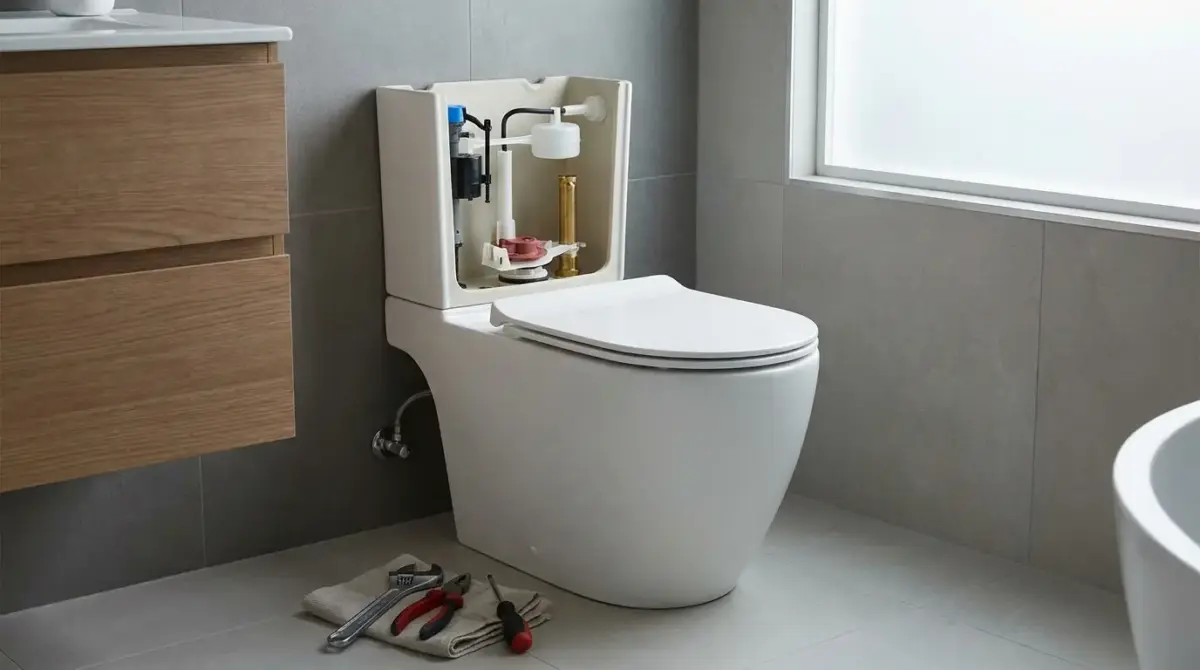
You hear water running constantly or in random short bursts every few minutes. This is almost always a leaking flapper — the rubber disc at the bottom of the tank that seals the flush valve.
Quick test: Drop a few drops of food coloring in the tank. Wait 15 minutes without flushing. If color appears in the bowl, the flapper is leaking.
Fix: Shut off the angle stop behind the toilet. Flush. Sponge out remaining water. Unclip the old flapper from the overflow tube and chain. Take it with you to the hardware store. Buy the matching one (universal flappers fit most toilets — $5-12). Install in reverse order. Five-minute job. According to the EPA WaterSense program, a leaking toilet flapper wastes up to 200 gallons per day — a huge water bill spike if left alone.
2. Toilet Won’t Stop Filling
The fill valve runs constantly and water trickles into the overflow tube. The tank water level is too high. This is a fill valve adjustment problem or a worn-out fill valve.
Fix attempt 1: Adjust the fill valve down. Modern fill valves have a clip or screw on the side that lowers the float. Set the water level about 1 inch below the top of the overflow tube.
Fix attempt 2: Replace the fill valve ($12-25). Slightly more involved than a flapper but still manageable for most homeowners. Shut off water, flush, sponge tank dry, unscrew old valve from underneath the tank, install new one, hook up the supply line.
3. Toilet Won’t Flush Fully
You flush and the water level drops slowly without the full siphon action. Most common cause: the flapper closes too fast because the chain length is wrong, or the rim jets are clogged with mineral scale from DFW hard water.
Fix the chain: The chain between the flush handle arm and the flapper should have about a half-inch of slack. Too tight and the flapper opens partially; too loose and it closes prematurely.
Fix the rim jets: Look under the toilet bowl rim with a flashlight. Calcium scale clogs the small holes that distribute water during a flush. Bend a piece of wire or use a small Allen key to scrape each hole clean. Pour a cup of CLR or vinegar into the overflow tube and let sit overnight for deeper descaling.
4. Wobbly Toilet
You sit down and the toilet moves. This is a wax ring or flange problem and it’s worse than it looks. A wobbly toilet allows sewage to leak out the bottom slowly, rotting the subfloor for years before anyone notices.
Fix: Pull the toilet, replace the wax ring ($8), reseat the toilet on a level base, tighten the closet bolts evenly. About 1-2 hours for a careful homeowner. If the flange itself is broken or recessed below floor level, you’ll need a flange spacer or repair kit and the job gets more complex.
If subfloor rot is visible when you pull the toilet, stop and call a plumber. That’s beyond a wax ring replacement.
5. Toilet Clog That Won’t Plunge
You plunge for 5 minutes and the water level doesn’t budge. The clog is past where the plunger can push it.
Fix: Use a closet auger (toilet snake). It’s a 3-foot rod with a curved end specifically designed not to scratch porcelain. $30 at any hardware store. Insert the curved end into the bowl, crank the handle to feed the cable through the trap, and physically break up or retrieve the clog.
If the closet auger doesn’t fix it, the clog is in the main line beyond the toilet. Stop trying DIY tools and call a plumber. Continuing to flush will overflow the toilet.
When Toilet Repair Doesn’t Make Sense (Replace Instead)
- Toilet is cracked anywhere — even hairline cracks worsen with use
- Toilet pre-dates 1994 federal water efficiency standards (uses 3.5+ gallons per flush — a new toilet pays back in water bills)
- Multiple repairs in the last 12 months
- Visible mineral scale damage from years of hard water
- Wobble caused by a broken flange that needs significant subfloor repair
A new mid-range toilet runs $200-400 plus $150-300 for installation. Often cheaper than three repair visits on an old unit.
DFW Hard Water and Your Toilet
North Texas hard water is brutal on toilets. Mineral scale builds up inside the tank, on the rim jets, in the trapway, and on the flapper seal. A toilet that should last 30 years often needs major component replacement within 10 in DFW. Installing a whole-house water softener — or at least running citric acid descaling treatments through your toilets every 6 months — extends component lifespan significantly.
Bottom Line
Most toilet repair in DFW is DIY-friendly: flapper, fill valve, chain adjustment, and wax ring jobs cost $5-30 in parts and 30 minutes of your time. The trick is correctly diagnosing the problem before you start swapping parts. Save the plumber call for wobbles with subfloor damage, repeated clogs that suggest a main line problem, or any leak you can’t trace.
Trusted Local Network
Basic toilet repair is the most accessible plumbing work for homeowners willing to spend 30 minutes watching a video. For homeowners outside DFW who want general handyman support that includes basic plumbing fixes, that scope is handled by local handyman contractors. And for out-of-area plumbing needs beyond DIY, regional plumbing services cover the same toilet repair and replacement work.
Your DFW Toilet Repair Specialists
If your toilet repair is past the DIY line, PACT Plumbing serves Dallas, Fort Worth, Plano, Frisco, McKinney, Carrollton, Keller, Southlake, Grapevine, and Roanoke with full toilet repair service and same-day diagnostics. Contact us today.