Sewer line replacement is one of the bigger plumbing projects any DFW homeowner can face — and the difference between getting it done right and getting it done wrong runs into thousands of dollars and weeks of disruption. This guide walks Dallas-Fort Worth homeowners through the warning signs that your sewer line needs replacement, what the actual options cost, and how to avoid the worst contractor mistakes that hit our area.
Before you sign anything: every sewer line replacement starts with a camera scope. Anyone who quotes you a price without seeing inside the pipe first is guessing.
If you are already seeing the warning signs below, our sewer line repair and replacement team starts with a camera inspection so you know what is wrong before any digging.
Worried about your sewer line? Call Pact Plumbing or send an inquiry and we will book a visit.
Warning Signs Your Sewer Line Is Failing
- Multiple drains backing up at once — tub fills when toilet flushes, sink burps when shower drains
- Recurring main line clogs — you’ve snaked the sewer line two or three times in a year
- Soggy patches in the yard above the sewer line — especially in summer when nothing else should be wet
- Sewer smell outside the house near the cleanout or along the sewer line path
- Foundation cracks or shifts along the line of the underground sewer
- Visible patches of unusually lush grass in a straight line (the leak fertilizes the lawn)
- Slow drains throughout the house that get worse over months
Two or more of these signs together means stop snaking and get a camera inspection. Repeatedly snaking a failing line just delays the inevitable while making the eventual replacement more expensive.
Why DFW Has So Many Sewer Line Problems
Three factors put North Texas sewer lines under more stress than most of the country:
Expansive clay soils. Houston Black and Houston clays — found throughout the Metroplex — swell and shrink dramatically with rainfall cycles. Every cycle stresses pipe joints. The Texas A&M Soil and Crop Sciences records soil movement of 4+ inches in some DFW areas.
Aggressive tree species. Crepe myrtles, cottonwoods, willows, and pecans all common in DFW yards send invasive roots into sewer lines through any tiny crack.
Older clay pipe. Homes built before the 1980s often have vitrified clay or “Orangeburg” tar-paper pipe that simply doesn’t last more than 50-60 years in DFW soils.
Repair vs Replace: How to Decide
Spot repair makes sense when:
- Camera scope shows one isolated break or crack
- Rest of the pipe is in good condition
- The line is less than 30 years old overall
Full replacement makes sense when:
- Pipe shows multiple defects along its length
- Pipe is original clay or Orangeburg material
- You’ve already done two or more spot repairs in recent years
- Bellied (sagging) sections that hold water permanently
- The line has lost more than 25% of its diameter to scale or root intrusion
Replacement Methods and DFW Costs
Traditional Trench Replacement
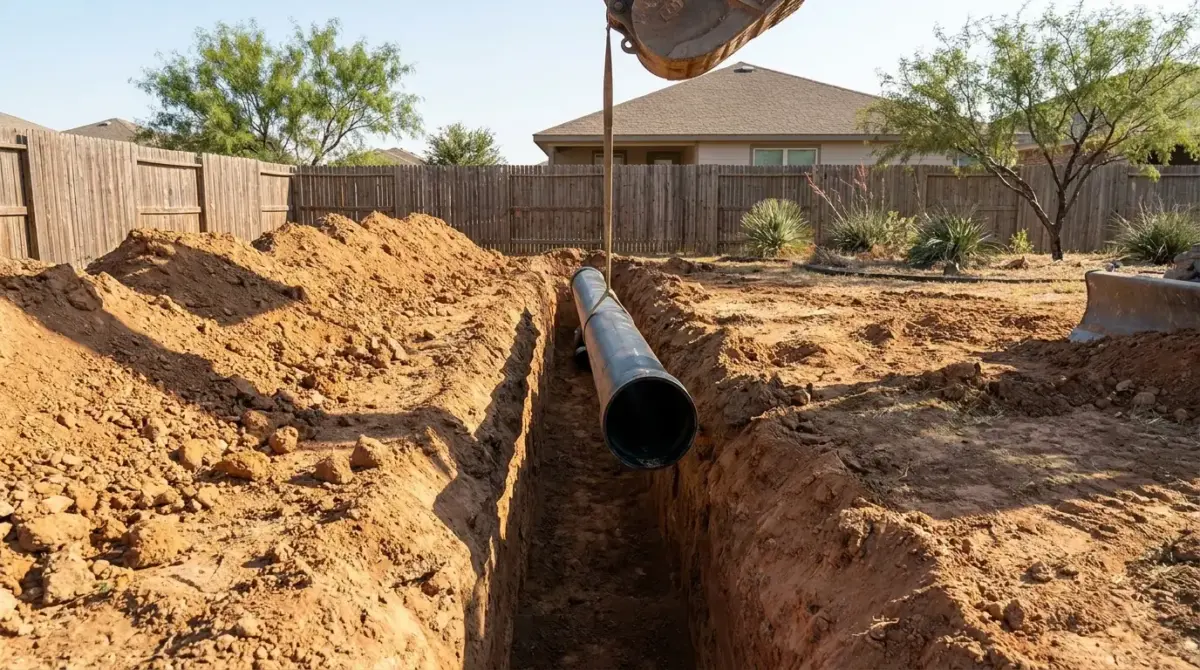
Excavator digs a trench from the house to the city tap. Old pipe out, new PVC in. Backfill, restore yard.
DFW cost: $50-125 per linear foot of pipe replaced, plus $2,000-6,000+ for yard restoration if you have hardscape or mature landscaping over the line.
Best when: the line runs under bare lawn with no significant landscape features.
Trenchless Pipe Bursting
Crews dig two small access pits (one near the house, one near the city tap). A bursting head is pulled through the old pipe, breaking it outward while pulling new HDPE pipe behind it. Yard stays largely intact.
DFW cost: $60-200 per linear foot. Higher per-foot than trench but dramatically lower yard restoration cost.
Best when: the line runs under concrete driveways, mature landscaping, hardscape, or finished outdoor spaces.
CIPP (Cured-In-Place Pipe) Lining
An epoxy-impregnated felt liner is inserted into the old pipe and inflated, then cured. Effectively a new pipe inside the old pipe shell.
DFW cost: $80-250 per linear foot.
Best when: the existing pipe still has structural integrity but cracks or root intrusion. Won’t work if the pipe is collapsed or severely deformed.
Permits and Inspections in DFW
Sewer line replacement requires permits from your city’s plumbing inspection department. Most DFW cities also require post-installation hydrostatic testing to confirm the new line holds pressure. A licensed plumber handles all permitting as part of the project. Anyone offering to “skip the permit” is also skipping the inspection that catches faulty installs — walk away.
The Texas Department of Licensing and Regulation maintains the master plumber registry for Texas — verify your contractor’s license before any work begins.
Insurance Coverage
Most homeowner policies do NOT cover sewer line replacement caused by normal wear, root intrusion, or soil movement. They sometimes cover damage caused by sewer backups. Service-line warranties (typically $5-15 per month from your water utility or a private warranty company) can cover the actual pipe replacement up to $10,000.
Check your homeowner policy and consider a service line warranty if you have an older home with original sewer infrastructure.
Bottom Line
Sewer line replacement is a major project but it’s also a one-time fix for problems that otherwise drain money for years. Get a camera scope before any work, pick the replacement method based on what’s above your sewer line, and use a licensed plumber who pulls the proper DFW permits. Done right, a new sewer line lasts 50-80 years.
Trusted Local Network
Sewer line replacement projects often involve tree removal and adjacent trades. For property owners outside DFW dealing with root intrusion that requires above-ground tree work, dedicated tree assessment and removal services handle that side. And for those needing sewer line repair services in other regions, local plumbing specialists cover the same diagnostic and trenchless work.
Your DFW Sewer Line Specialists
If your sewer line is failing, PACT Plumbing serves Dallas, Fort Worth, Plano, Frisco, McKinney, Carrollton, Keller, Southlake, Grapevine, and Roanoke with camera-scope diagnostics and full sewer line repair and replacement services. Contact us today.