
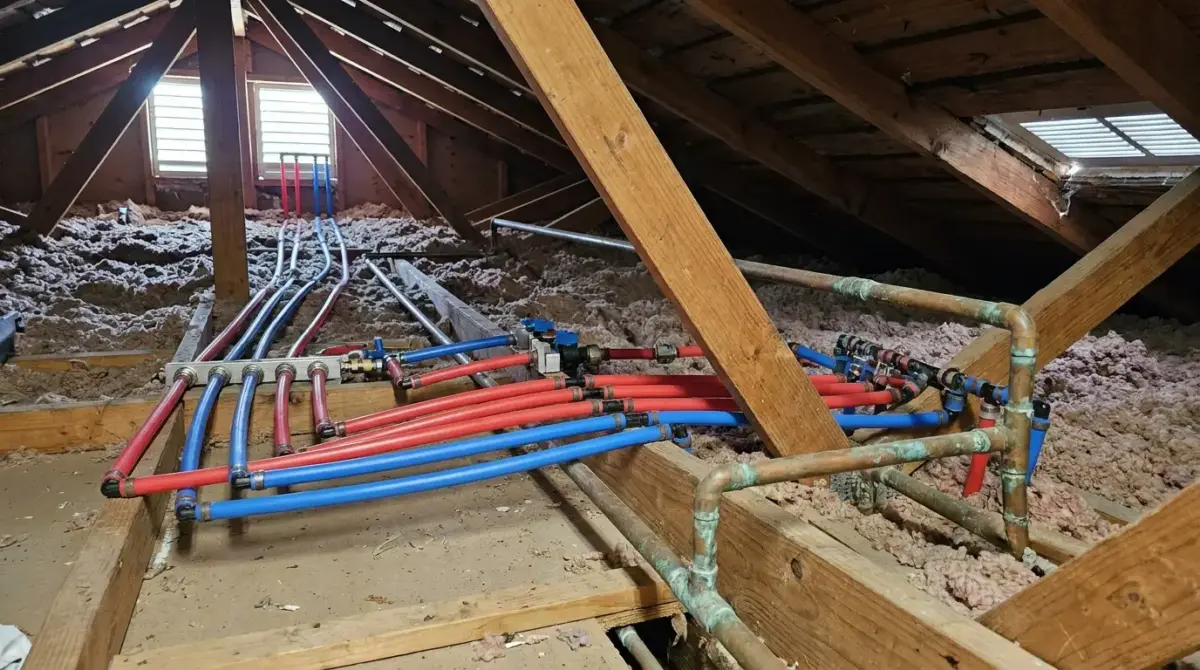
Choosing between a PEX repipe and a copper repipe is one of the biggest plumbing decisions a DFW homeowner can make — and the answer is different in North Texas than in many other parts of the country. Hard water, expansive clay soils, and the climate all favor one option over the other for most Dallas-Fort Worth properties. This guide walks DFW homeowners through how to choose between PEX repipe and copper, what each costs, and what to expect long-term.
If your home needs a full or partial repipe, our pipes and drains service covers repiping across Dallas-Fort Worth and can walk you through the PEX and copper options below for your house.
Thinking about a repipe? Call Pact Plumbing or send an inquiry and we will book a visit.
When You Actually Need a Repipe
- Galvanized supply lines from a pre-1970 home
- Multiple pinhole leaks in copper pipe (usually means the rest is failing too)
- Low water pressure throughout the house from scaled-up old pipes
- Rusty or discolored water from old galvanized
- Constant slab leaks suggesting widespread copper failure
- Major renovation that opens walls anyway
A repipe is a 5-10 day project that touches every wall, ceiling, and floor where water lines run. It’s not a small job. But for the right house, it’s a one-time fix that lasts 50+ years.
PEX Repipe in DFW: The Modern Choice
PEX (cross-linked polyethylene) is a flexible plastic pipe that’s become the standard for residential repipes across DFW. Why it wins for most Texas homes:
Hard Water Resistance
PEX doesn’t develop mineral scale buildup like copper does. North Texas hard water that destroys copper plumbing in 30-40 years doesn’t damage PEX. This alone makes PEX the better choice for most DFW homes.
Freeze Tolerance
PEX expands up to 8% when water freezes inside, instead of bursting like copper does. In post-2021 DFW where freeze events are now common, this is a major durability advantage.
Faster, Cheaper Installation
PEX is flexible, so it threads through walls and around obstacles without elbow joints at every turn. Installation time is roughly half that of copper. Lower labor cost translates to a $2,000-5,000 cheaper repipe for a typical DFW house.
Fewer Joints to Fail
PEX comes in 100-foot rolls, so a typical bathroom can be plumbed with no joints between the main and the fixture. Fewer joints = fewer potential leak points over 50 years.
Copper: When It Still Wins
Copper isn’t dead — it still has legitimate advantages for certain situations:
- UV resistance — copper handles outdoor exposed installations better than PEX (UV degrades PEX over time)
- High-temperature applications — recirculation loops in tankless systems often spec copper for the immediate output line
- HOA or building code requirements — some older DFW HOAs and historic district codes still specify copper
- Resale perception — some buyers see copper as “premium” even though PEX is equally code-compliant and more durable in hard water
DFW Cost Comparison (2026)
- PEX repipe: $4,000-9,000 for an average 2,000 sq ft DFW home
- Copper repipe: $7,000-14,000 for the same home
- Hybrid (PEX + copper at fixtures): $5,500-11,000 — sometimes used to meet specific code requirements
Pricing varies based on home size, attic vs slab plumbing routing, number of bathrooms, accessibility, and whether walls have to be opened or attic-routed.
PEX A vs PEX B
If you choose PEX repipe, two grades are commonly used in DFW:
PEX A (Uponor brand or equivalent) — most flexible, best freeze tolerance, easiest to expand-fit joints. Higher material cost but typically the better long-term value.
PEX B — standard for most DFW residential installations. Lower material cost, uses crimp-fittings. Reliable when properly installed.
Both are code-approved under the Texas Plumbing Code. Differences are technical — most homeowners won’t notice in practice.
What Happens During a Repipe
- Plumber pulls necessary permits with your DFW city
- Initial inspection to map existing routing and identify problem points
- New pipe routed through attic and walls (typically attic-routed in DFW slab homes for easier access)
- Cut-overs at each fixture — new pipe connected, old pipe abandoned in place
- Drywall patches at any access cuts needed
- Pressure testing and city inspection
- Texture and paint repairs
Typical timeline: 3-5 days for plumbing work, then 1-2 weeks for drywall and paint repairs.
Warranty Comparison
PEX manufacturers like Uponor offer 25-year warranties on the pipe itself, often extended to lifetime warranties with certified installers. Copper has no manufacturer warranty (the metal is just metal) but is expected to last 50+ years if water quality is good.
Your installing plumber should provide a separate workmanship warranty (typically 1-5 years) covering installation defects.
Bottom Line
For most DFW homes needing a repipe, PEX wins — better freeze tolerance, immune to hard water scale, faster installation, lower cost. Copper still makes sense for outdoor exposed applications or specific code situations. Either way, a permitted repipe by a licensed plumber is one of those rare home investments that’s both a major upgrade and a permanent fix.
Trusted Local Network
PEX repipe projects often surface HVAC coordination needs since pipes and ductwork share wall and crawl space access points. For related needs, we recommend repipe services in the SoCal market.
Your DFW Repipe Specialists
If your DFW home needs a PEX repipe or you want a quote on copper vs PEX for your specific property, PACT Plumbing serves Dallas, Fort Worth, Plano, Frisco, McKinney, Carrollton, Keller, Southlake, Grapevine, and Roanoke with full pipes and drains service including complete home repipes. Contact us today.