
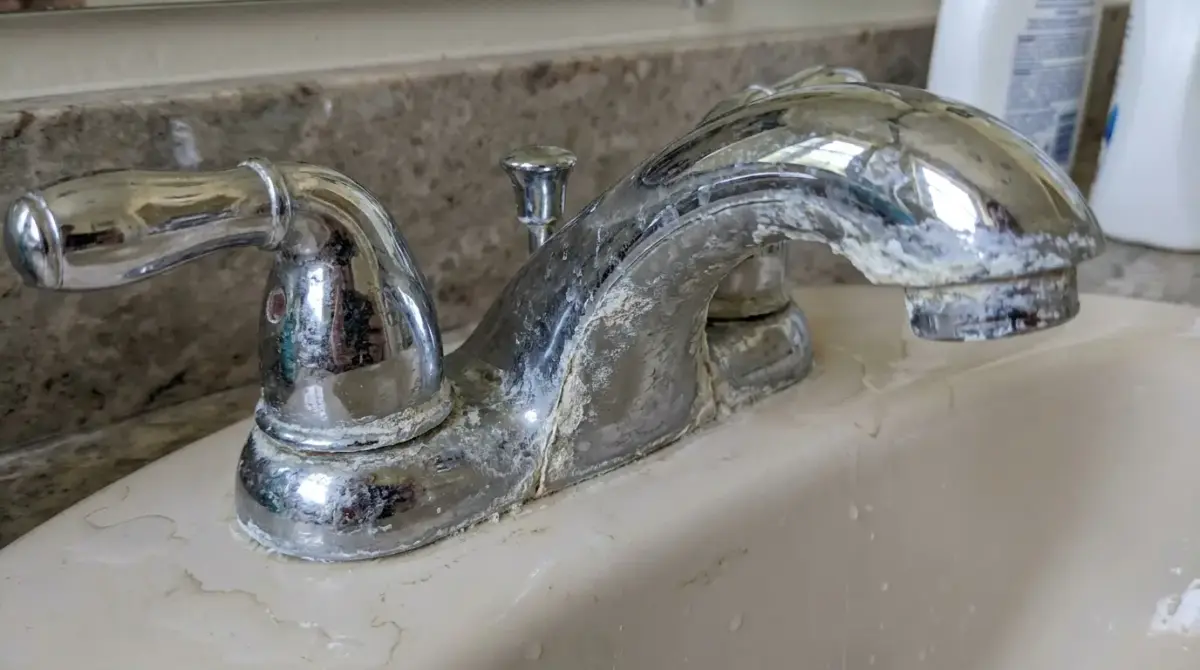
Hard water is one of the most underestimated plumbing problems in Dallas-Fort Worth. North Texas water hardness measures 12 to 18 grains per gallon — well into “very hard” territory on the USGS scale — and that mineral content is slowly destroying water heaters, faucets, dishwashers, and supply lines across every neighborhood in the Metroplex. This guide walks DFW homeowners through what hard water actually does, how to spot the damage, and what works (and doesn’t) for fixing it.
What Hard Water Actually Is
Hard water is water with high concentrations of dissolved calcium and magnesium. According to the USGS Water Hardness map, anything over 180 mg/L (about 10.5 grains per gallon) is “very hard.” Most of DFW measures 200-300 mg/L — among the hardest in the country.
The minerals themselves aren’t harmful to drink. The problem is what they do when water gets heated or evaporated. They precipitate out and form rock-hard mineral scale on every surface the water touches.
What Hard Water Does to Your Plumbing
1. Kills Water Heaters Years Early
The biggest casualty. Hard water sediment settles to the bottom of tank water heaters, insulating the burner from the water above. The burner runs longer and hotter to compensate. The bottom of the tank warps, the heating element burns out, and the tank itself fails 30-50% sooner than rated. A water heater that should last 12 years often dies at 7 in DFW.
2. Clogs Faucet Aerators and Showerheads
The white crusty buildup on every faucet in your house is calcium scale. It restricts flow, creates uneven spray patterns on showerheads, and eventually requires replacement of fixtures that should last decades.
3. Damages Dishwashers and Washing Machines
Heating elements scale up. Spray arms clog. Detergent doesn’t dissolve properly. Glassware comes out cloudy. Clothes look dingy. Hard water shortens appliance lifespan and increases detergent use by 50% or more.
4. Reduces Pipe Diameter Over Decades
Inside galvanized and even copper pipes, scale slowly builds up on the walls. A pipe that started with a 3/4-inch interior diameter can be reduced to 1/2 inch or less after 20 years of DFW hard water. Water pressure drops. Flow gets sluggish. Eventually pipes have to be replaced.
5. Damages Skin and Hair
Soap doesn’t lather well in hard water. It combines with the minerals and forms a sticky scum that’s hard to rinse off. Dry skin, dull hair, and eczema flare-ups are all worse in hard-water households.
Where DFW’s Hard Water Comes From
Most of the Metroplex gets water from surface reservoirs through the North Texas Municipal Water District or similar regional providers. Those reservoirs sit on limestone bedrock and naturally pick up high mineral loads. Treatment plants disinfect and clarify the water but don’t soften it before delivery.
Translation: every drop of city water arriving at your house is loaded with calcium and magnesium. The only way to remove it is at the point of entry.
How to Fix It: Real Solutions
Whole-House Water Softener (Best for Hard Water)
The standard solution. Salt-based ion-exchange softener swaps calcium and magnesium for sodium, dramatically reducing scale formation. Soft water through every faucet, every appliance, every pipe. Lifespan of water heaters and fixtures roughly doubles. DFW installation typically runs $1,500 to $3,500 depending on home size and water usage. The system pays for itself in extended appliance life within 5-7 years.
Salt-Free Conditioner
Marketed as a softener alternative. Doesn’t actually remove minerals — it crystallizes them so they don’t stick to surfaces as readily. Better than nothing. Significantly less effective than true ion-exchange softening for severe DFW hard water. Use only if you can’t have salt regeneration or have very mild hardness.
Point-of-Use Filters
Reverse osmosis at the kitchen sink for drinking water, in-line shower filters for bathing. Useful supplements but don’t address scale in water heaters, appliances, or supply lines elsewhere in the house.
Annual Maintenance That Helps
- Flush your water heater tank annually to clear sediment
- Soak showerheads and faucet aerators in vinegar quarterly to dissolve scale
- Replace water softener salt as needed (typical home uses one bag every 4-6 weeks)
- Run an empty dishwasher cycle with citric acid every few months
- Inspect supply lines under sinks for visible scale buildup once a year
How to Test Your Home’s Hard Water Level
Don’t guess your hardness level. Test kits are cheap and tell you exactly where your home sits on the hard water scale. Three options:
- Test strips ($10 at any hardware store) — dip in tap water, compare color to chart. Gives you grains-per-gallon reading in 30 seconds
- Liquid drop test kit ($15) — more accurate than strips, useful for sizing a softener
- Professional water analysis ($75-150) — full breakdown of hardness, iron, chlorine, pH, and total dissolved solids. Recommended before installing any whole-house system
If you test and find your hard water reads 7+ grains per gallon, a softener pays back. Above 10 grains per gallon (where DFW lives), it’s essential for protecting your water heater investment.
Common DFW Hard Water Myths
Myth: hard water tastes bad. Actually most people prefer the taste of mineral-rich water. The “bad taste” usually comes from chlorine, not hardness. A whole-house filter with carbon stage handles taste; a softener handles scale.
Myth: softeners make water taste salty. A properly sized softener adds barely any sodium to your water — typical added sodium is less than what’s in a slice of bread per gallon. People on extreme low-sodium diets can install a potassium-based system instead.
Myth: bottled water solves the problem. Bottled water only fixes drinking water taste. It does nothing for the scale destroying your water heater, dishwasher, faucets, and supply lines.
Bottom Line
Hard water is doing measurable damage to every DFW home’s plumbing right now. The water itself is safe to drink, but the long-term cost of doing nothing — premature water heater replacement, scale-clogged fixtures, shortened appliance lifespan — adds up to thousands of dollars over a decade. A whole-house softener is the proven fix.
Trusted Local Network
Hard water doesn’t just affect indoor plumbing. Pool and spa equipment in hard-water regions deals with similar mineral scale on heaters, salt cells, and pump impellers — specialized pool equipment mineral-management services cover that scope. And when hard water causes water heater failure that floods the garage, professional water damage restoration services handle the recovery side for affected property owners.
Your DFW Water Softener Specialists
If you’re tired of fighting hard water in your DFW home, PACT Plumbing serves Dallas, Fort Worth, Plano, Frisco, McKinney, Carrollton, Keller, Southlake, Grapevine, and Roanoke with water softener and filtration systems sized for your home and water usage. Contact us today.